
After subdued earnings in the first half amid global headwinds, India Inc is taking a cautious approach on their capital expenditure (capex) for the second half of the financial year ending March 2025, according to management commentary. Minutes from the October monetary policy meeting show the Reserve Bank of India's (RBI's) optimism about private investments picking up.

Bharti Airtel is the largest mobile phone operator in the country.

The licensee will have to ensure that at least half the areas under rural telecom exchanges gets the required street level coverage.

Will help the government expand mobile and broadband penetration in the country

A delay would also result in a loss of opportunity to add at least 10 million broadband customers per year, which would have helped increase broadband penetration. India had a total of 5.65 million broadband connections as on January 31, 2009, way below the 9-million subscriber target set by the DoT for 2007. The meagre growth -- the country is adding around 1 million subscribers per annum -- will make it difficult to meet the government's target of 20 million users by 2010.
Serious technology challenges await Reliance.

Telecom operator Bharti Airtel reported more than 2.5 times jump in its consolidated profit to Rs 4,160 crore in the April-June quarter of 2024-25 compared to the year-ago period driven by an improvement in average revenue per user and an exceptional gain of Rs 735 crore. The company had posted a profit of Rs 1,612.5 crore in the same period a year ago. The consolidated revenue from operations of Bharti Airtel increased by 2.8 per cent to Rs 38,506.4 crore during the reported quarter from Rs 37,440 crore in the June quarter of the last year.

Telecom companies have put in bids worth Rs 58,332 crore (Rs 583.32 billion) in spectrum auction at the end of 49 rounds on the 7th day of bidding on Monday.

DoT and the company have not done anything that breached the guidelines mentioned in the notice inviting applications for the auction of the BWA spectrum in 2010, it stated in a reply to CAG's draft audit report.
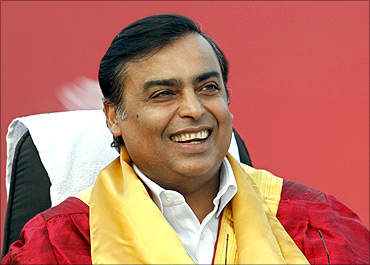
Telecom operator Reliance Jio Infocomm has arranged credit facilities worth $1.5 billion with lenders, including Bank of America and Barclays, to refinance existing loans.

'We operate in 16 countries already, and therefore adding the UK to it, and beginning a chapter in the European continent is the next step.'

The launch of 5G services in India turbocharged mobile download speeds here, pushing the country's ranking 72 notches higher to 47th spot in Speedtest Global Index, ahead of nations like Japan, the UK and Brazil, according to Ookla. India's speed performance has zoomed up 3.59 times since the introduction of 5G, it said dubbing the country's 5G advancement as "remarkable". In this global pecking order, India ranked not only ahead of its neighbours like Bangladesh, Sri Lanka, and Pakistan, but also some G20 countries, such as Mexico (90th), Turkey (68th), the UK (62nd), Japan (58th), Brazil (50th place), and South Africa (48th place).

Says spending $3 billion every year on networks alone

RIL has signed an infrastructure sharing agreement with Reliance Communications (RCom, of the Dhirubhai Ambani group) to launch its services.

Reliance Jio may not ask for a premium for its 5G services in the initial stages of the launch, according to sources in the company. The company will roll out 5G commercial services in four cities -Delhi, Mumbai, Chennai, and Kolkata - around Diwali this month and slowly ramp up the processes for other cities, too. A senior executive, when asked whether Jio will charge higher tariffs for 5G against 4G, said: "In the initial stages, customers have to adopt 5G, then they will have to find value in the service, and then one can look at monetisation."

When, recently, Bharti Airtel announced a Rs 21,000 crore rights issue, analysts pointed out that its structure was similar to that of Reliance's issue in June 2020. One similarity is that shareholders in both companies have to pay only 25 per cent of the money on application. The rest is to be paid in two tranches. In Bharti Airtel's case, it is within 36 months; in Reliance Jio's, it is within 17 months.

It's time the government accepts that Digital India is too distant.

Govt is set to garner Rs 1 lakh crore from sale of radiowaves.

Consumers can expect a 5G launch in the country soon. Telecom companies (telcos) say if auctions take place on time - the target is July - they would be able to offer some services in a few cities by the end of this year and a full roll-out from 2023. But the question is: will 5G turn the tables for telcos financially? Will average revenue per user (ARPU) improve? Will mobile consumers upgrade to 5G quickly and pay more? Will the expanded functions that 5G enables drum up sufficient revenues? In simple terms, will telcos make more money?
The amount generated so far is about 86 per cent of what the 3G auction fetched in 2010.

The uniform SUC, if implemented as per recommendations made by Telecom Regulatory Authority of India, will provide relief for mobile operators such as Airtel, Vodafone and Idea, but will increase rates for broadband wireless access spectrum holders like RJIL.
The government will get an additional revenue of 20 per cent from the auction of the 1,800 MHz and 900 MHz bands of spectrum, based on the Telecom Commission's recommendations, compared with those of the Telecom Regulatory Authority of India (Trai).

To revive the two state-run telecom operators, Bharat Sanchar Nigam Limited (BSNL) and Mahanagar Telephone Nigam Ltd (MTNL), the government is likely to waive the one-time fee these telcos need to pay for retaining additional spectrum.

Broadband connectivity to villages has been lagging, with delay in laying of an optical fibre network up to gram panchayats

The auction will help operators augment expansion of high-speed 4G voice and data services in the world's second largest mobile phone market.

The interconnection charge has been reduced.

'Considering that an Internet company's market value is largely determined by its direct access to consumers for digital services, and largely served outside a sovereign country's control, it would appear reasonable in trade terms to discuss fees for a seat at the proverbial 'table' of opportunities in the largest open consumer market,' argues Venki Nishtala.

Its says reconsider lower reserve price, uniform usage charges; GSM players to bear the brunt.

In the quarter ending June 2022, the growth of Internet subscribers was less than one per cent of all of 2021.

Pricing is a vital part of strategy to take high speed broadband to 265 million homes
A gap has long existed between India's tech savvy and its access to broadband Internet, which some estimates peg at a mere 0.3 per cent of the population

Spectrum auction took off on Wednesday from Rs 58,980.29 crore (Rs 589.80 billion) mark with demand for the premium 900 Mhz band seemingly tapering off at the end of 56 rounds.
Telecom companies put in bids worth a total of about Rs 45,000 crore (Rs 450 billion) on the second day of the auction on Tuesday, with premium 900 Mhz band in Delhi, Mumbai and Kolkata witnessing continuing demand.

Raises cap of market share for merged entity to 50%, spectrum trading allowed, with riders.
Discussing the prospect of more reform earlier this month, telecom minister Ashwini Vaishnaw announced a delay in the 5G spectrum auction. India's telecom sector regulation has to be benchmarked with the global best, he said. It's another matter that many countries have either introduced or are about to roll out 5G services that will enable cutting-edge tech in diverse areas. For India, too, it will mean a lot for healthcare, robotics and unleashing a new chapter in Digital India perhaps.

In the not too distant future, you could see 5G technology being used for functions such as remotely-performed robotic surgeries, mine equipment operated remotely or cars driven by someone sitting hundreds of miles away. While these ideas will certainly find application globally, the urgent need for them in India could spur swifter adoption here than elsewhere.
Rs 200-cr burden likely for TV rating agencies.

DoT plans to initiate move that might lower the revenues telcos share with government.

While the draft M&A policy for the telecom sector has been revised a few times over the past few months, DoT has not made any major changes to guidelines.

India must change approach and have better access to networks to fulfil its digitisation dream.
